
Heavy rain from Tropical Cyclone Damien caused the Murchison River to flood in early February. At Mt Padbury, 706 kilometres upstream from the mouth at Kalbarri, the river was as big as the record flood of 2006 caused by TC Emma. The difference with this event was that because Damien brought rain only as far west as Berringarra the amount of water in the river downstream would not be as much as in 2006 – with the bonus that the roads west and south of Milly Milly would be dry and accessible. Good news for the Support Crew ‘chasing’ the boats.
The plan was to leave Cockburn on Thursday afternoon, travel to Pithara, camp the night and continue to the river the next day. North through Cue and on to Berringarra Station to find where would be the best place to launch the boats. The plan was for the Support Crew to follow the boats to Minnawarra Crossing –an on-water distance of about 100 kilometres, depending on the start point. The next day was planned for the on-water expedition to reach Ballinyoo Bridge – a distance of about 82 kilometres.
As per usual on these types of trips the reality was somewhat different from the planning.
-

- Bungarra or sand monitor (Varanus gouldii).
We arrived at Beringarra Station mid-afternoon on Friday 21 February and on advice from the station manager, travelled upriver towards Kalamunda Pool, about 20 kilometres to the east. Past cattle yards east of the homestead the track was difficult to follow, however, we were able to drive along a fence line heading generally in the required direction. Two attempts to find a way down to the water resulted in boggings both times. The entire country had been underwater only four days previously.
-

- Even without the drag of the trailer the Navara would have bogged in the soft, wet ground.
-

- Navara and trailer bogged.
-

- The Navara was pulled out backwards.
-

- Patrol vs soft, wet soil.
-

- The Sierra was the closest vehicle around and, given enough attempts, would have eventually moved the Patrol, however, a heavier vehicle was required.
-

- Aftermath of retrieving Aaron’s Patrol.
It was getting late so we decided to camp where we were – about five kilometres upriver from the station homestead. As matters transpired the next day it was fortunate that the Boat Crews did not start here – or further up – as this stretch of the Murchison River is very much a ‘braided stream’. A multitude of channels from which to choose, one indistinguishable from the next, some leading nowhere, others joining up, some shallow, others with sufficient water, together present a serious challenge to navigation.
The flies, mosquitoes and other bugs, combined with high humidity made for an uncomfortable night.
-

- First night’s campsite after repeated attempts to find a way to the river
Very early the next morning we headed back to the Mt Gould Road Crossing where we were confident we could launch the boats.
-

- Approaching the river.
-

- A large rock in front of the left rear wheel stopped the Navara getting through the slop.
-

- The offending rock that stopped the Navara from initially getting through the slop.
-

- The river flowing across the road for a week caused more damage than the passage of four vehicles, despite appearances.
Getting to the river was a challenge. The floodwaters had destroyed the road in one 50 metre section. The nearest we could get to the water was only about 200 metres. The boats were prepared and the crews dragged/walked to the main stream flow.
-

- After the Navara got through the boghole Greg shifted a large rock that was causing difficulties.
-

- Alan made easy work of getting through in the Landcruiser.
-

- Preparing for the start.
-

- Air was bubbling out of the ground at a number of locations.
-

- Greg, Cliff and Matt preparing the boat for the start.
-

- Ready to start.
The Murchison River Expedition 2020 was off and running, 576 kilometres upstream from the mouth at Kalbarri and 46 kilometres further upriver than our previous record start.
The Support Crew moved to the first rendezvous at Milly Milly Crossing. This was on a side channel of the main river.
-

- Mlily Milly Station
The entire Support Crew got out their camp chairs and sat on the crossing in the water, cooling off, waiting for the arrival of the boats and crew.
-

- Support Crew sitting under the shade of a tree in the river at the Milly Milly Crossing.
-

- A couple of cows , too timid to walk past the Support Crew seated on the crossing, swam the river.
-

- The two cows that swam the river meet up with the cow that calmly walked across it, past the Support Crew.
The boat journey was short lived. The crew were having a very difficult time finding the river proper. The myriad channels in this highly braided section of river all got too shallow, too soon. It quickly became untenable.
A sat phone message revealed that the Boat Crew were returning to the start point on the Mt Gould Road. They had navigated only three kilometres before the lack of water and confusing channels necessitated a return.
The Support Crew returned to the Mt Gould Road Crossing and retrieved the boats and crew.
The Expedition moved to Milly Milly Crossing where the boats were re-launched upstream with the intention of getting through to the main river.
-

- Putting in at Milly Milly Crossing.
-

- Alan leaves the boats.
-
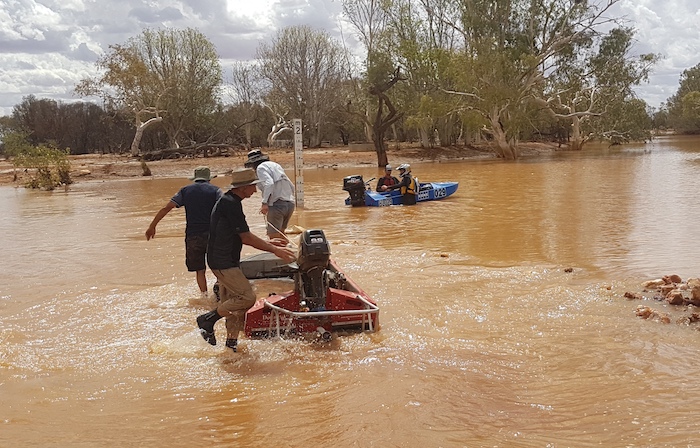
- The upriver restart.
-

- Plenty of water at Milly Milly Crossing.
-

- Restart.
Meanwhile the Support Crew drove to the Byro-Beringarra Road Crossing (the main channel of the Murchison) to confirm they could access the river. The issue was that while the boats could set off downriver from the Milly Milly Crossing channel there was no assurance the they could join the main river. It was way more preferable that they be launched into the main river (at some point upriver from the Milly Milly Crossing but downriver from the Mt Gould Road Crossing) and it was imperative that the Support Crew vehicles could get to the Byro-Beringarra Crossing to refuel them.

Aaron headed out from Milly Milly Crossing to confirm that he could navigate the seven kilometres to the main river. A short time later a radio message came through that he was bogged and was self-recovering.
-

- Aaron slid off the road at a mudhole and then got bogged. His attempt at self recovery was less than successful.
The remainder of the Support Crew moved up to his location to help with the recovery. After varying opinions on the best way to extricate the vehicle it was decided to tow it out backwards.
The team carried on to the main river, confirmed access, and then returned to Milly Milly Crossing to await the arrival of the Boat Crews. The Boat Crews had radioed through that they couldn’t find a way through to the main river and would have to return to Milly Milly Crossing.
The boats were retrieved from the water at Milly Milly Crossing, loaded on the trailers and taken upriver to Cadjacootharra, a possible checkpoint identified in the planning stage of the Expedition. Earlier in the day Mushy had driven into the point and found it to be suitable for launching the boats. The new launching point for tomorrow was decided! And because it was so late in the day, the location of the campsite for the night self-selected.
The boats were offloaded at the river’s edge and tied to trees. The campsite was about two hundred metres to the south, just off the Byro-Beringarra Road.
A storm cell hit before we had a chance to set up camp. Lightning and thunder had been all around for 20 minutes. The ferocity of the storm was amazing. The temperature plummeted. Water was pouring off awnings. Anything not undercover was drenched. The flies persisted.
-

- Start of the squall.
-

- The beginning of the rain from the storm cell.
-

- Alan’s camp.
-

- Aaron and Greg’s camp was underwater in no time.
Some of the crew took the opportunity to have a wash or even a full on shower.
Next morning there was little evidence of the previous night’s downpour.
-

- Little evidence of the previous night 25mm downpour.
The ever-present, clinging bush flies were annoying in the extreme but could not detract from the accomplishment of putting power dinghies on a wild river 556 kilometres into the outback in extreme conditions (40+degrees, 98% humidity). Twenty six years after the first bold attempt, and six subsequent forays, the challenge is there for anyone else to surpass this achievement. I’m confident that any other power boating trips on the Murchison will be restricted to ten kilometres upriver from Kalbarri!
-

- Alan, Greg and Cliff getting the boat ready to start.
-

- Greg preparing boat.
-

- Nat and Steve dragging their boat to the water at Cadjacoothara.
-

- Steve and Nat dragging their boat into the water.
-

- Ready to start at Cadjacoothara.
-
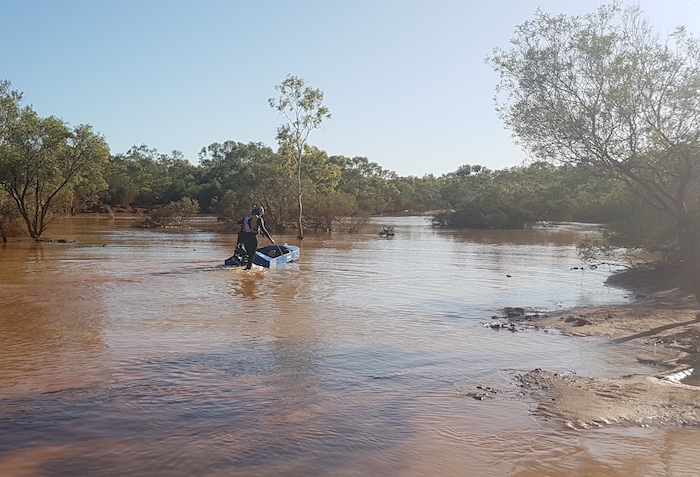
- Start of an historic boat trip at Cadjacootharra, 556 kilometres from the mouth.
The Support Crew moved down to Byro-Beringarra Crossing to refuel the boats coming downriver from Cadjacootharra.
-

- Mushy set up camp at the water’s edge.
-

- Alan at the Byro-Beringarra Road Crossing.
-

- Cliff and Greg come in to refuel
-

- at the Byro-Beringarra Road Crossing checkpoint.
-

- Byro-Beringarra Road Crossing
-

- Steve and Nat at the refuel checkpoint.
The boats were refuelled and a new coordinate was entered into the GPS. The crews were given strict instructions not to go past Manfred, 42 kilometres downstream. The inability of the Support Crew to get through to the boats, for any number of reasons, was a potentially serious issue.
-

- Heading south towards Manfred.
-

- Heading south towards Manfred.
The Support Crew followed station tracks south that would lead them to Manfred. A well-constructed fence blocked the way, forcing an unwanted deviation to the east to the Pindar Road.
Rains from the storm cell last night had extended many kilometres to the south and the runoff from the high ground to the north-east made travel along the fenceline treacherous.
-

- Navara and Patrol bogged along fenceline.
-

- Aaron used Matt’s Navara as an anchor from which to winch out his Patrol.
-

- Matt pulls in Aarons winch rope.
-

- Aaron winched his Patrol out of the boghole.
A six kilometre deviation brought the Support Crew to the end of the fenceline. A quick dash through a recently-flooded creek got all vehicles onto the Beringarra-Pindar Road. It was then a 65 kilometre drive to the Manfred Road turnoff and a 35 kilometre drive into the river – if the rain from last night’s storms hadn’t washed out the track.
After ten or so kilometres I decided that it wasn’t wise to send all vehicles in to Manfred without knowing for certain that the track was open. We stopped, set up an awning and waited for information from the Boat Crew. Mushy headed off to find a way through to the river at Manfred. Fuel for vehicles was becoming an issue and I wanted to avoid unnecessary travel. A sat phone message came through from the Boat Crew advising that they had reached the rendezvous point at Manfred. Some time later another message confirmed that Mushy had got through. The remainder of the Support Crew were then able to confidently head to Manfred.
-

- Alan takes the Landcruiser through the creek.
-

- Matt in the Navara.
-

- Steve’s crossing was more spectacular.
-

- Tank at the entrance to Manfred Station.
-

- Manfred Station
On arrival at the station it was revealed that the boats were still two kilometres away from the point the vehicles could reach on the flooded track. However, Steve was able to navigate the boats through some minor channels to get to where the Support Crew was waiting on the flooded track.
-

- Aaron and Mushy found their way to the main channel a few kilometres south of where the boat crews had stopped and, for a while, it was contemplated to navigate to this point to get off the river.
-

- The main river a few kilometres down from Manfred.
-

- Murchison River at Manfred.
-

- The ground close to the river was treacherous. Even the lightweight Sierra got bogged.
-
- The easy way to get the boats to the trailers.
-

- Steve towed the boats from the river.
-

- Boats ready to be loaded on trailers.
It was very hot and very humid. Eventually the boats were loaded and equipment secured. ready to head off.
The remaining range of the vehicles was a concern. The nearest fuel was at Mullewa, 186 kilometres distant. Steve was carrying jerry cans of diesel and was able to share it around before we headed south towards camp.
Camp was a clearing off to the side of the road. The flies were as bad as ever.
-

- Matt and Kim’s camp.
-

- Aaron and Greg’s camp.
-
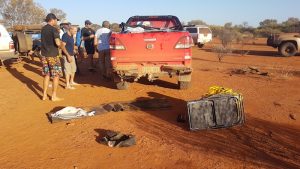
- Gear out to start the wheel change.
-

- Steve and Nat changing the wheel.
In the morning while re-inflating tyres road pressures Steve noticed he had a slow leak, caused by a staked sidewall. As soon as the wheel was changed the long journey home began.
Feel free to use any part of this document but please do the right thing and give attribution. It will enhance the SEO of your website/blog, and this website.
Text and Layout © Cockburn 4WD Club 2020 and Kim Epton 2020
Photographs Michael Orr, Kim Epton
2200 words, 73 images.
See Terms of Use